 (Image source: Gemini)
 You have probably seen saffron in a fancy risotto or a active paella, usually accompanied by a price tag that makes you double-check your bank balance. There is a reason for that. It takes roughly 75,000 crocus flowers to produce a single pound of the spice. For centuries, it was the ultimate culinary flex. But lately, the conversation has shifted from the kitchen to the medicine cabinet. Saffron is having a massive moment in the wellness world, and it is not just because it looks pretty in a glass jar.
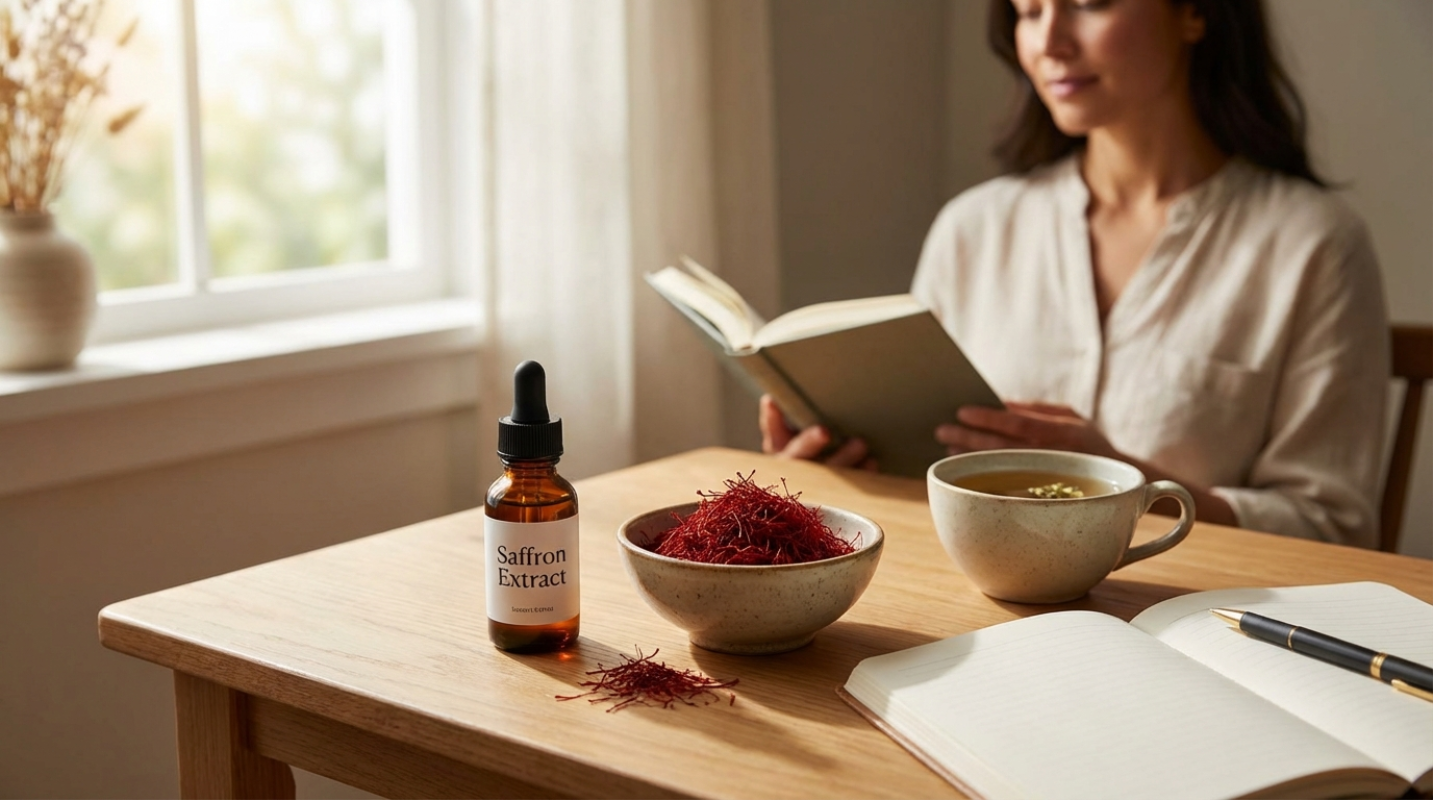
So what changed? We stopped just eating it for flavor and started looking at what it does to our brains. When we talk about saffron for emotional balance and focus, we are not talking about the threads you buy at the grocery store. You would have to eat a lot of expensive rice to get a therapeutic dose. Instead, we are looking at saffron extract. This is a concentrated form that pulls out the heavy hitters: crocin and safranal.
Think of crocin as the mood-brightener. It is the compound responsible for that deep red color, but in your brain, it works on serotonergic pathways. Then you have safranal, which is more about stress resilience and calming focus. Together, they create a botanical one-two punch that helps you stay level-headed when life gets chaotic. It is the difference between trying to fix a leaky faucet with a butter knife versus having the actual wrench. One is a kitchen staple, the other is a precision tool.
The Evidence Base Clinical Trials Supporting Emotional Balance and Focus Support
If you are skeptical of "natural" remedies, you are in good company. Most of us want to see the receipts before we start a new supplement. Fortunately, the research into standardized saffron extract has exploded over the last couple of years. By 2026, the data has moved from "promising" to "clinically validated."
One of the most significant pieces of evidence comes from a massive 2025 study published in The Journal of Nutrition, which followed over 200 participants. The results were hard to ignore. About 72% of the people taking a standardized saffron extract showed significant emotional improvement compared to just over half in the placebo group. We are talking about a 53% reduction in low mood symptoms over 12 weeks. The best part? People started feeling the difference as early as week five.
But it is not just about feeling "happier." It is about staying sharp. If you have ever struggled with that mid-afternoon brain fog or felt like your focus is a browser with 50 tabs open, saffron might be the "refresh" button you need. Recent trials have compared saffron extract to traditional stimulants for ADHD symptoms. In several studies, 30mg of saffron was found to be non-inferior to methylphenidate (Ritalin) for managing hyperactivity. Although the pharmaceutical might still have a slight edge for pure inattention, saffron has a massive advantage: it actually helps you fall asleep faster, whereas stimulants usually keep you staring at the ceiling at 2 a.m.
How does it do this? It comes down to neurotransmitters. Research from 2024 and 2025 suggests that saffron inhibits the reuptake of dopamine and norepinephrine. These are the chemicals responsible for sustained attention and executive function. It is basically helping your brain keep more of the "good stuff" in circulation for longer.
Decoding the Label What to Look For in a High-Quality Saffron Extract
Now that you are sold on the "why," we need to talk about the "what." Walking into a supplement aisle and grabbing the first bottle with a flower on it is a recipe for disappointment. The supplement industry is notorious for being a bit like the Wild West, and saffron is one of the most frequently adulterated products on earth.
The first thing you need to look for is standardization. If a label just says "Saffron Powder," put it back. You want an extract that is standardized for its active compounds. Specifically, look for crocin (ideally between 7.5% and 10%) and safranal (between 0.3% and 1%). If the company cannot tell you the percentage of these actives, they probably do not know what is in the bottle themselves.
You also want to look for the testing method. For a long time, the industry used a standard called ISO 3632, which uses UV-Vis testing. The problem? That method is easily fooled by certain dyes and fillers. The gold standard now is HPLC (High-Performance Liquid Chromatography). It is a much more precise way to verify that the crocin and safranal are actually there and not just a chemical ghost of themselves.
In terms of dosage, most successful clinical trials settle on a range of 28mg to 30mg per day. Usually, this is split into two doses (14mg or 15mg each). Taking a massive 500mg dose of "saffron powder" is actually less effective than taking 30mg of a highly concentrated, standardized extract. It is about quality, not volume.
Where the Treasure Lies Vetting Suppliers for Purity and Potency
Saffron is so expensive that people have been faking it for centuries. In the past, people used everything from dyed corn silk to shredded horsehair. Today, the "fakes" are more sophisticated, often involving low-quality extracts spiked with synthetic dyes. This is why where you buy it matters more than almost any other supplement.
Your best bet is to look for branded ingredients. Companies like Affron, Safr'Inside, and Saffr'Activ spend millions on clinical trials and quality control. When you see those names on a supplement label, it means the manufacturer bought a high-quality, pre-verified raw material. Like, Affron is standardized to a specific complex called Lepticrosalides, which has been the subject of most of the big mood and focus studies you will read about.
Beyond the brand of the extract, check for third-party verification. Look for the NSF or USP seals on the bottle. These organizations act like the "police" of the supplement world, verifying that what is on the label is actually what is in the capsule. Also, pay attention to the country of origin. High-quality saffron typically comes from Iran, Spain, or the Kashmir region. If the bottle is vague about where the plants were grown, that is a red flag.
Integrating Saffron for Best Emotional Balance A Witty User’s Guide
So, you have got your high-quality extract. Now what? Do you just pop a pill and wait for enlightenment? Not exactly. Saffron is a tool, not a magic wand. If you want to get the most out of it, you need to be smart about how you use it.
Timing is everything. For focus support, most people find that taking their first dose in the morning with breakfast works best. It sets the tone for the day. If you are using it for emotional balance or to help with that "tired but wired" feeling in the evening, taking your second dose with dinner can help smooth out the transition into sleep. Unlike caffeine, it won't give you the jitters, so you don't have to worry about a "crash."
You might also consider teamwork. Saffron plays very well with other adaptogens like ashwagandha or magnesium. Although saffron works on the dopamine and serotonin side of things, magnesium can help with physical relaxation. It is like having a good DJ and a comfortable lounge area at the same party. They work better together.
Finally, manage your expectations. Although the 2025 studies showed benefits as early as five weeks, some people need a full 8 to 12 weeks to feel the full effect. Think of it more like a slow-burn romance than a whirlwind fling. It takes time to build that foundation of emotional resilience. But once it is there, you will likely find that the "lows" aren't quite as low, and the "focus" isn't quite as hard to find.
This article on zenugen.com is for informational and educational purposes only. Readers are encouraged to consult qualified professionals and verify details with official sources before making decisions. This content does not constitute professional advice.