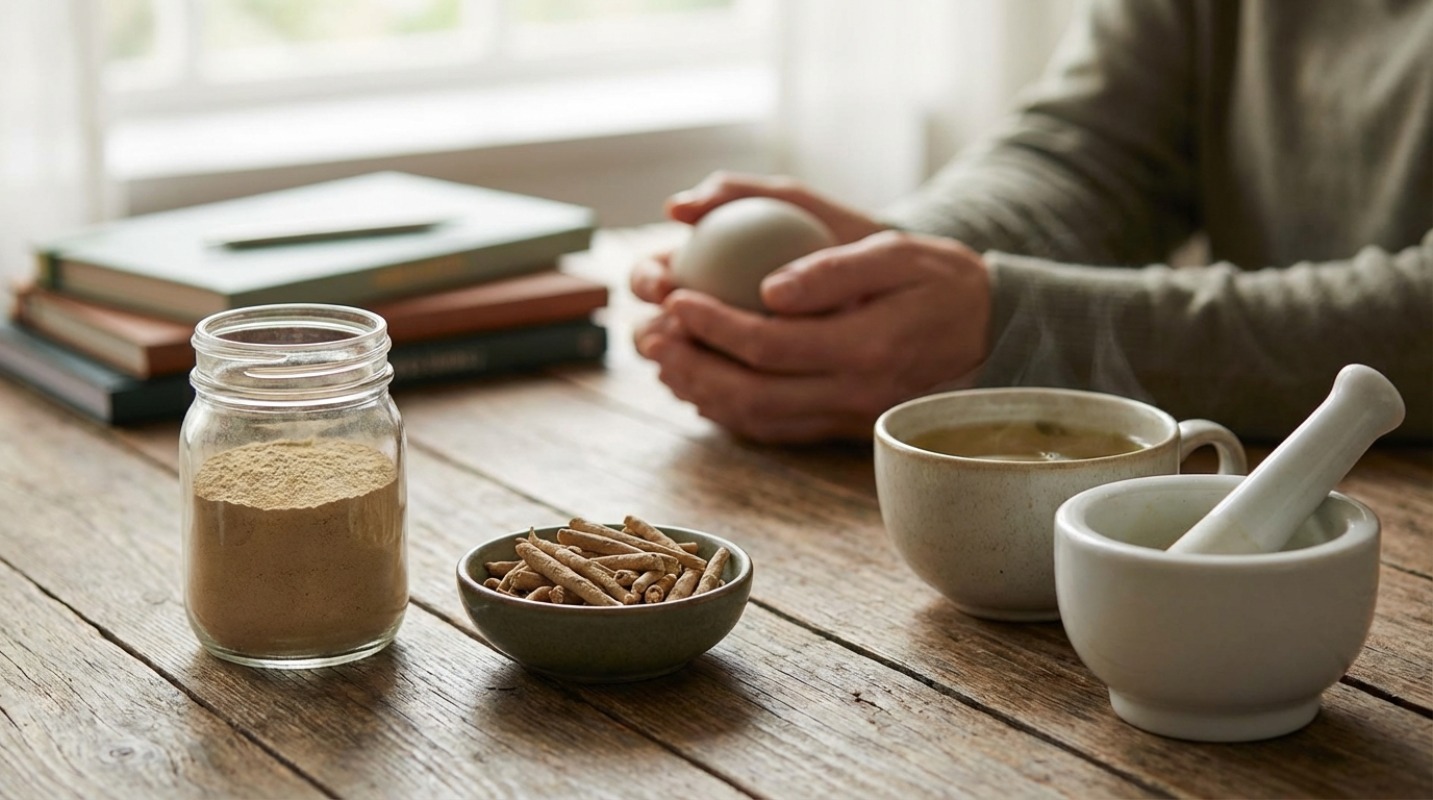
 (Image source: Gemini)
 Have you ever felt like your body is a smoke alarm that just won't shut up? You're sitting at your desk, perhaps sipping a lukewarm coffee, but your heart is racing as if you're sprinting away from a hungry tiger. That's cortisol for you. It's your body's primary stress hormone, and while it's supposed to be your best friend during a genuine emergency, it's become a bit of a nuisance in our modern lives.
In a perfect world, cortisol follows a beautiful, natural rhythm. It spikes in the morning to help you wake up and then slowly drifts down throughout the day so you can sleep at night. But we don't live in a perfect world. We live in a world of Slack notifications, traffic jams, and doom-scrolling. For about 40% of people right now, that "fight or flight" response never actually turns off.
Think of chronic stress like a perpetually ringing smoke alarm. In a real fire, you want that noise. It saves your life. But when the alarm is screaming because you slightly over-toasted a bagel, or worse, for no reason at all, it becomes a problem. Over time, these constant cortisol spikes do more than just make you feel jittery. They mess with your blood sugar, your sleep, and even your ability to remember where you put your keys.
So what does this actually mean for your daily life? It means you're operating in a state of biological survival when you're just trying to get through a Tuesday. Your body thinks it's running a marathon every single day, and frankly, it's exhausted. This is where the modern stress epidemic lives, right at the intersection of your adrenal glands and your overflowing inbox.
Enter Ashwagandha Nature's Chill Pill (Backed by Science)
If you've spent any time in a health food store lately, you've probably seen Ashwagandha (Withania somnifera) staring back at you from the shelves. It's not just a trendy root. It's an adaptogen, which is a fancy way of saying it helps your body "adapt" to stress. Although it has been a staple in Ayurvedic medicine for thousands of years, the science has finally caught up to the tradition.
The real magic happens when we move past generic root powders and look at standardized ashwagandha extracts. If you buy a bag of raw ashwagandha powder, you have no idea how much of the active "good stuff" is actually in there. It's like the difference between chewing on a random coffee bean and drinking a precisely brewed espresso. Standardized extracts like Shoden, KSM-66, or Sensoril make sure you're getting a specific concentration of withanolides, the compounds that do the heavy lifting.
The core mechanism of ashwagandha is its ability to act as a thermostat for your adrenal glands. It works directly on your HPA (Hypothalamic-Pituitary-Adrenal) axis. This is the communication line between your brain and your stress response system. When the brain starts screaming "Panic!" the ashwagandha extract helps dial that signal down. It doesn't just block the stress. It helps normalize the secretion of cortisol so you don't overreact to every little thing.
Dr. Andrew Youssouf, a medical director who focuses on recovery, noted recently that ashwagandha prevents that excessive elevation during stress. It's not about making you feel numb or sedated. It's about keeping your biological "smoke alarm" from going off when there isn't actually a fire.
The Clinical Evidence What Recent Studies Say About Cortisol Management
We aren't just guessing that this works anymore. The data from 2024 and 2025 has been remarkably clear. A major systematic review published in late 2023 confirmed that taking ashwagandha for 30 to 112 days results in measurable and significant reductions in serum cortisol levels. This isn't just people "feeling" better. This is actual bloodwork showing lower levels of the stress hormone.
One of the most impressive breakthroughs recently came from a study published in the journal Heliyon in August 2024. Researchers tested a high-potency extract called Shoden, which is standardized to 35% withanolide glycosides. The results were staggering. Participants taking a very small dose (between 60mg and 120mg) saw their morning cortisol levels drop by 66% and 67% respectively. To put that in perspective, the group taking a placebo only saw a 2.2% change.
Another meta-analysis from 2024, which looked at 15 different randomized controlled trials involving nearly 900 people, found a statistically significant reduction in cortisol across the board after 8 weeks of use. On average, people saw a drop of about 12% to 16% in their general cortisol levels, with even higher drops for those who were severely stressed.
But why do some extracts work better than others? It comes down to the chemical nature of those withanolides. Dr. Benny Antony has pointed out that withanolide glycosides are the real key drivers here. These specific compounds have a longer half-life in your body. This means they stay in your bloodstream longer, helping to manage those unpredictable cortisol spikes that happen throughout your workday.
Beyond the Spike Secondary Benefits of Taming Your Stress Hormone
When you manage to lower your chronic cortisol levels, the benefits start to ripple out into every other part of your life. The most immediate change most people notice is in their sleep. Have you ever been "tired but wired"? That's usually the result of a cortisol spike happening right when you should be winding down. By blunting that spike, ashwagandha helps you fall asleep faster and improves the quality of that sleep.
Then there's the brain fog. High cortisol is like static on a radio station. It makes it incredibly hard to focus on a single task because your brain is constantly scanning for threats. When you dial down that hormone, the static clears. Many users report improved cognitive function and a better ability to stay on task without feeling overwhelmed by their to-do list.
There's also a metabolic component to this. Cortisol is notorious for telling your body to store fat, especially around the midsection, because it thinks you need "emergency fuel" for your marathon. By normalizing your stress response, you're telling your metabolism that the emergency is over. This can lead to better mood stability and even support your physical fitness goals by preventing the muscle breakdown that often comes with chronic stress.
Making it Work Integrating Ashwagandha Extract Into Your Daily Routine
If you're ready to try this out, don't just grab the first bottle you see. Quality matters immensely here. The American Botanical Council actually issued a warning in 2024 about products being "watered down" with cheap leaf material to fake a high potency. You want to look for "standardized" labels and third-party testing.
Recommendations
For timing, you have a few options. Many people prefer taking it in the morning to handle the stress of the day, while others take it in the evening to support better sleep. If you're using a high-potency extract like Shoden, you might only need one small dose. If you're using something like KSM-66, which is standardized to 5%, you'll likely need a higher dose (around 600mg) split between morning and night.
Keep in mind that this isn't an overnight fix. Although you might feel a bit calmer within a few days, the clinical "gold standard" for seeing the full physiological benefits is about 8 weeks. Most of the 2024 studies showed that the peak reduction in cortisol happened between the 60 and 90-day marks. Consistency is your best friend here.
A quick word of caution: if you have a thyroid condition or an autoimmune disorder, you should definitely talk to your doctor first. Some regulatory agencies, like Denmark's, have been cautious about ashwagandha because of its potential impact on hormones. It's powerful stuff, so treat it with respect.
Managing your stress isn't about trying to eliminate every difficult thing in your life. That's impossible. Instead, it's about learning to dial down the volume of your body's response. You can't always stop the "smoke alarm" from being triggered by the world around you, but with the right extract, you can make sure it doesn't keep ringing long after the toast is done.
This article on zenugen.com is for informational and educational purposes only. Readers are encouraged to consult qualified professionals and verify details with official sources before making decisions. This content does not constitute professional advice.